Reading the Bible is one of the most foundational Christian disciplines. Yet many Christians struggle to read the Bible consistently.
In fact, according to research, only 32% of Christians read the Bible daily and only 18% have ever read the entire Bible.
In this guide, we’ll explore what reading the Bible is, why it matters and how you can begin building a consistent Bible reading habit in your everyday life.

This article contains affiliate links. This means if you click on a link and make a purchase, I may get a commission, but you will not be charged a penny more. Thanks for your support!
What is the spiritual discipline of reading the Bible?
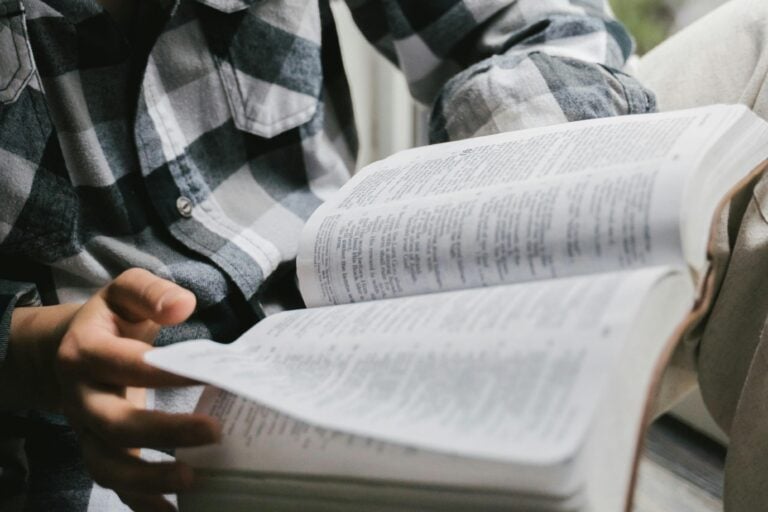
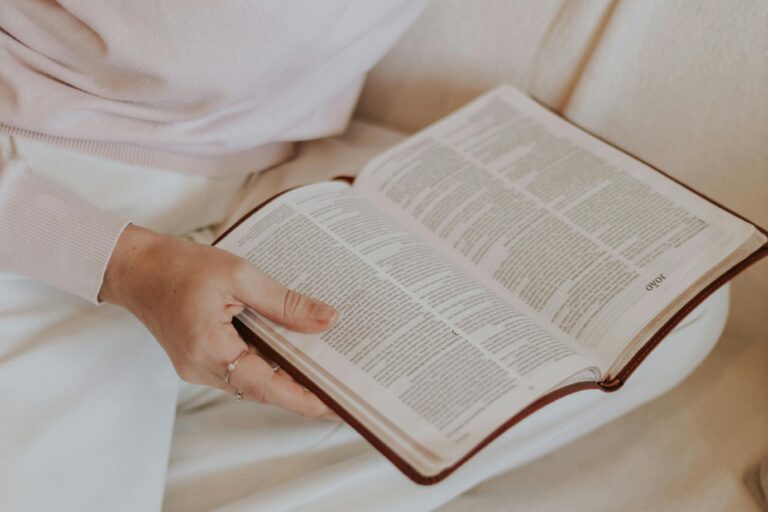
Reading the Bible is a spiritual discipline where you simply read the Bible.
It is different from studying the Bible.
When you study the Bible you go deep. You may spend many days just on one short passage. You may read it in different translations. You’ll probably read commentaries. You might look up words in the original language. And you’ll likely compare cross-references, explore the historical and cultural background and dig deeply into what the passage means.
Reading the Bible sits at the opposite end of the spectrum.
You simply read.
When you read the Bible, you typically read a longer portion of the Bible and you don’t go so deep.
Of course, in practice, you’ll probably want to note down some observations, look up a few things, consider how the passage applies to your life and pray over what you have read.
But mostly you just read.
Why read the Bible?
There are so many good reasons to read the Bible! Here are 5:
1. The Bible tells us to
All throughout Scripture we see God’s people are commanded to read his Word.
Joshua 1:8 says:
“Keep this Book of the Law always on your lips; meditate on it day and night, so that you may be careful to do everything written in it. Then you will be prosperous and successful.” (NIV)
Psalm 1:1-2 says:
“Blessed is the one… whose delight is in the law of the Lord, and who meditates on his law day and night.” (NIV)
And in Matthew 4:4, Jesus says:
“It is written: ‘Man shall not live on bread alone, but on every word that comes from the mouth of God.’” (NIV)
We also see examples in the Bible of when God’s people are commended for reading the Word. For example, in Acts 17:11 the Bereans are commended for reading the Scriptures daily.
And we also see examples in Scripture of how everything goes horribly wrong when God’s people neglect his Word.
2. You are what you “eat”
Romans 12:2 says:
“Do not conform to the pattern of this world, but be transformed by the renewing of your mind. Then you will be able to test and approve what God’s will is—his good, pleasing and perfect will.” (NIV)
There’s a popular saying that, “You are what you eat.”
A variation on that saying is, “You are what you consume.”
If your main “diet” is social media, TV, the news and other people, then THAT is what you’ll become like.
If, on the other hand, you consistently spend time reading the Bible each day, THAT is what will shape you.
Or in other words, if you want to be less worldly and more godly, you need to spend more time reading the Bible!
3. It helps us grow closer to God
In a normal human relationship it’s true that, the more time you spend with that person, the closer the relationship you have with them.
Well, the same is true with God. The more time we spend reading God’s word, the more we learn about his character and what he has done for us, and the closer to him we grow.
The Bible is no ordinary book. It’s not just words on the page. It’s the main way that God speaks to us today.
Hebrews 4:12 says the Word of God is “alive and active”.
If prayer is the main way that we speak to God, the Bible is the main way that God speaks to us.
4. It changes you
Hebrews 4:12 says:
“For the word of God is alive and active. Sharper than any double-edged sword, it penetrates even to dividing soul and spirit, joints and marrow; it judges the thoughts and attitudes of the heart.” (NIV)
As we consistently read the Bible each day we change – we are prompted to confess our sins and become less selfish, prideful, self-reliant and anxious.
And we are gradually transformed – we become more loving, more patient, more peaceful, more gentle, more humble, more selfless and less anxious.
In short, we become more Christlike.
5. It gives us wisdom and guidance
The Bible is clear that, as we read the Bible, we will grow in wisdom.
Psalm 19:7 says:
“The law of the Lord is perfect, refreshing the soul. The statutes of the Lord are trustworthy, making wise the simple.” (NIV)
The Bible is also the main way that God guides us.
Psalm 119:105 says:
“Your word is a lamp for my feet, a light on my path.” (NIV)
While 2 Timothy 3:16-17 says:
“All Scripture is God-breathed and is useful for teaching, rebuking, correcting and training in righteousness, so that the servant of God may be thoroughly equipped for every good work.” (NIV)
READ MORE >>> Why should Christians read the Bible?
Which is better: reading the Bible or studying the Bible?
Both reading the Bible and studying the Bible are valuable.
We STUDY the Bible to get depth – a deeper, richer understanding of God and his Word.
We READ the Bible to get breadth – the big picture view of Scripture, and how everything fits together.
Both give us rich insights into God and his character.
Both will transform us by the renewing of our minds.
But on a purely practical level, studying takes much longer – and most Christians will never be able to STUDY the whole of the Bible in their lifetimes.
But, if they choose to, most Christians will be able to READ the whole Bible multiple times in their lifetime.
And as we know from 2 Timothy 3:16:
“All Scripture is God-breathed and is useful for teaching, rebuking, correcting and training in righteousness.” (NIV)
ALL Scripture.
So then, it’s important to read the Bible as well as study it – that way you will not miss out on parts of the Bible. And that way you will get a better understanding of Scripture as a whole.
If you are new to the Bible, I recommend you start by reading it first – to get that ‘big picture view’ first – then dive into studying the parts that you most want to study.
If you have read and/or studied bits of the Bible over the years, but you’ve never read all of it, I recommend you aim to read the whole of the Bible over the next 1-3 years.
READ MORE >>> Which is the best Bible reading plan?
Is just reading and studying the Bible sufficient?
One mistake that some Christians make is they think that just reading and/or studying the Bible is sufficient.
But the Bible is clear. It’s not enough just to read the Bible – we must put what we have learned into action.
James 1: 22-25 says:
“Do not merely listen to the word, and so deceive yourselves. Do what it says. Anyone who listens to the word but does not do what it says is like someone who looks at his face in a mirror and, after looking at himself, goes away and immediately forgets what he looks like. But whoever looks intently into the perfect law that gives freedom and continues in it – not forgetting what they have heard but doing it – they will be blessed in what they do.” (NIV)
Whenever you read the Bible, you should always ask yourself the question, “What is the application?” or, in other words, “What is this passage telling me to DO?”
And then actually do that thing!
How to read the Bible
On one level, the answer to “How should I read the Bible?” is just “read the Bible”.
But many Christians try this and get stuck pretty quickly.
One helpful approach is to choose a Bible reading plan (see below for some suggestions) and then use the S.O.A.P. Method to help structure your daily Bible reading times.
S.O.A.P. stands for:
Scripture: Simply read today’s passage from your daily reading plan.
Observation: Next, jot down in a journal or notebook anything that stands out to you. For example: the main theme of the passage, any key words and repeated phrases, who is speaking and who the audience is, anything it tells you about God’s character, any questions you have, and anything else that stands out to you.
Application: Consider how the passage applies to your life right now. Ask yourself what changes you need to make. Is there a command to follow? A promise to hold onto? A temptation to avoid? A sin to confess? An attitude you need to change? Or a thing you need to do more of? Write down one or two concrete, actionable steps in your journal.
Prayer: Close your session by saying or writing a prayer to God. I recommend praying back to God what you have learned. For example, if the passage reveals something about God’s character, praise him for it. If it reveals a sin you have committed, confess that sin and ask for his help to resist doing it again in the future. If the passage talks about something God has done, thank him for it. And pray for God’s help to do whatever application you found.
READ MORE >>> What is the S.O.A.P. method for reading the Bible?
READ MORE >>> How to read the Bible
What is the best Bible reading plan?
Another thing that many people struggle with when reading the Bible is where to start. Many Christians start with Genesis… but fizzle out when they hit Leviticus!
Often, people try to read the Bible in one year – but that means reading an average of 3 chapters a day, which is way too much for a lot people – especially if reading is something they struggle with.
If you have struggled with similar problems in the past. I recommend you find a good Bible reading plan to help you.
There are many good Bible reading plans, but here are two of my favourite…
The MNM-GLEJ method
Hands down my favourite Bible reading plan is the is the MNM-GLEJ method. It might sound silly, but it makes perfect sense when you know what it stands for!
It stands for
M – Matthew
N – New Testament
M – Mark
G – Genesis to 2 Chronicles
L – Luke
E – Ezra to Malachi
J – John
You can go as fast or as slow as you want, but I recommend aiming for one chapter per day.
If you read one chapter per day, you will read the whole of the bible in a little over 3 years.
The gospels are read at the beginning and end of the plan, as well as at the end of the New Testament and halfway through the Old Testament.
This plan keeps the Gospels central, provides balance and structure, and covers all of the books of the Bible, while also being generally a little easier than starting from Genesis!
It will also help you read the Old Testament in the light of the New Testament.
The Bible Recap
If you really want to read the Bible in a year, then I highly recommend The Bible Recap.
The Bible Recap is a chronological reading plan with short daily summaries and explanations that help you understand what you’ve just read… It makes reading the Bible in a year fun, engaging… and actually doable!
READ MORE >>> What is the best Bible reading plan?
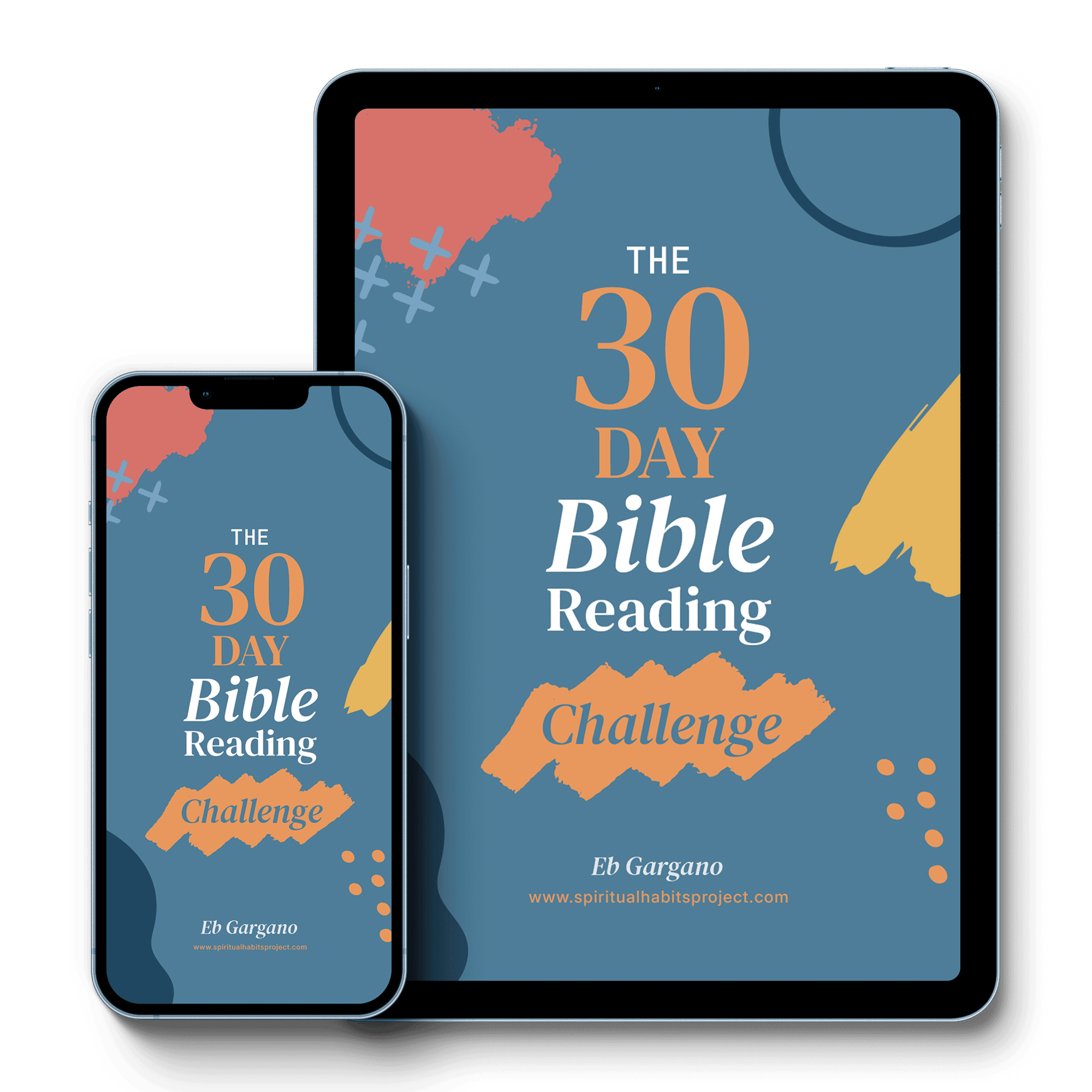
If you are just getting started, or you want less to read each day, try The 30 Day Bible Reading Challenge! Each day includes a few verses of Scripture to read, a short teaching on that Scripture, a guided prayer activity, a related challenge to do during the day and journal prompts to help you reflect on what you’ve learned and how you are growing.
Which is the best Bible translation to read?
Another thing that trips people up when they come to start reading the Bible is which translation to use. There are so many of them!
The first thing to say is, there is no one perfect translation!
The original Bible was written in Hebrew, Greek and Aramaic. So, if you are reading the Bible in English you will be reading a translation. And, as anyone who has ever done any translation will tell you, there is no such thing as a ‘perfect’ translation.
That being said, most Bible translations are done with a huge amount of care, by expert Bible translators, with much diligence – and lots of prayer!
My advice is to pick one of the most popular translations – and (unless you particularly like reading old English) a translation that is written in modern English.
Good options include:
- New International Version (NIV)
- English Standard Version (ESV)
- New Living Translation (NLT)
- New King James Version (NKJV)
- New American Standard Bible (NASB)
- New Revised Standard Version (NRSV)
Don’t get too hung up over your choice. Just pick one and start reading!
And if you just can’t choose and want me to choose for you, go for the NIV. It’s the world’s best-selling modern English translation, and it’s also the one I read most often personally, and it’s the one I quote most often on this website.
SIDE NOTE: For many people around the world, their favourite translation is the original King James Version. This is a good translation, but it is written in Old English (like Shakespeare) and so it can be quite difficult to understand, which is why I don’t generally recommend it – especially to people who are new to studying the Bible. That being said, if the KJV is your favourite translation, then by all means use it!
Bible reading as a spiritual discipline
Reading the Bible is a spiritual discipline because it requires intention and consistency.
Spiritual growth isn’t about random bursts of devotion or occasional spiritual highs. It’s about building rhythms that shape your heart over time. Just as exercise strengthens the body, spiritual disciplines strengthen our relationship with God and help us grow in Christlikeness.
Reading the Bible sits alongside the other spiritual disciplines – like prayer, fasting, fellowship, service, evangelism – each one helping us remain rooted in God and formed into the likeness of Christ.
Read More >>> What are the spiritual disciplines?
How to start a Bible reading habit
Building a Bible reading habit doesn’t have to be complicated or overwhelming. Here are some practical steps to get started:
1. Start small
Begin with 10 minutes a day. You are much more likely to succeed if you aim for 10 minutes a day than if you aim for a much longer Bible reading session.
Often you’ll find that, once you start, you end up reading for much longer! But if you aim for a long Bible reading session, you’ll likely find yourself skipping your Bible time on busy days.
It is much better to read the Bible consistently for 10 minutes every day, than have the intention of a longer session that never happens!
2. Choose a consistent time
I highly recommend making your Bible reading time as soon as possible after you wake up in the morning. It sets the tone for your day and helps prevent distraction from taking over.
3. Keep a journal
Use this to jot down observations, questions, applications and prayers. This will help you remember what you have read and learned. It will help you track your spiritual growth. And it will also keep you accountable – you can go back and check to see if you are actually doing the applications!
4. Start and end with prayer
Before you get started reading the Bible say a short prayer asking God to speak to you through his Word today – to help you understand it better AND to help you meet with him.
After you’ve finished, say another prayer, thanking God for what he has revealed to you and asking for his help in putting what you have learned into practice.
5. Use the S.O.A.P. model
There’s no one right way to read the Bible, but many Christians find the S.O.A.P. model a useful tool.
S.O.A.P. stands for Scripture, Observation, Application, Prayer. It provides a simple structure that helps you focus on both the meaning and the application of the passage.
Read More >>> What is the S.O.A.P. model of reading the Bible?
6. Focus on consistency, not perfection
Some days will feel rich and focused. Others will feel distracted, difficult and frustrating. Keep showing up anyway. Faithfulness over time is what shapes us.
As you keep showing up consistently over time, you will discover that reading the Bible becomes less of a task and more of a joy – a daily appointment with the King of Heaven. What could be more exciting than that?
Your Next Step: The 30 Day Bible Reading Challenge
If you want help building a consistent Bible reading habit, then I invite you to join the 30 Day Bible Reading Challenge.
Each day includes:
- A short Scripture passage to read
- A brief teaching on the passage
- A guided prayer activity
- A short, related challenge to do at another point in the day
- Reflection questions to help you track your growth
In just 30 days, you’ll begin to build a foundation for a steady, sustainable Bible reading habit
Join the 30 Day Bible Reading Challenge!
Final Thoughts
Reading the Bible consistently is one of the most powerful spiritual habits you can build.
You don’t need a perfect plan or hours of free time – you simply need to start and keep going.
As you grow in the habit of daily Bible reading, you will gradually discover that God’s Word shapes how you think, guides how you live and draws you closer to him.
Recommended resources for reading the Bible
- God’s Big Picture – Vaughan Roberts
- The Bible Course – The Bible Society
- The Bible Recap – Tara-Leigh Cobble
- The Bible Revealed – Philip Yancey & Brenda Quinn
- The NIV Life Application Study Bible – Tyndale House
READ MORE >>> Recommended resources for reading the Bible
Pin this article
Scripture copyright and permissions
For information about the Bible translations used on this website and their copyright notices, please see the Scripture copyright and permissions page.