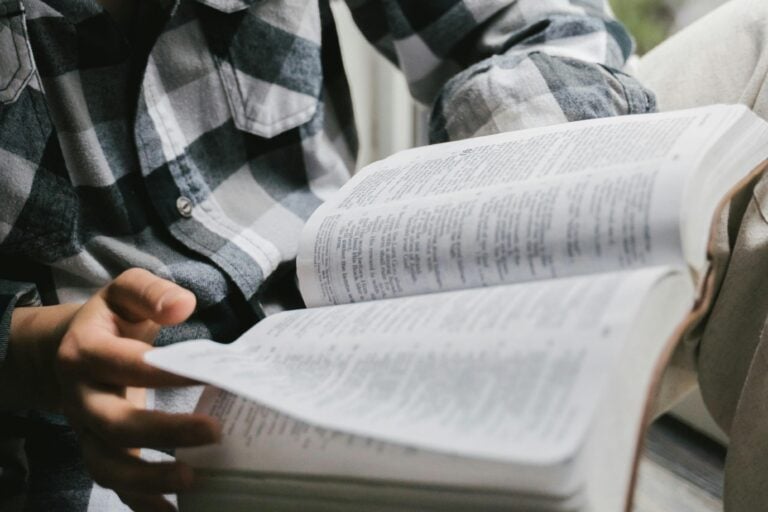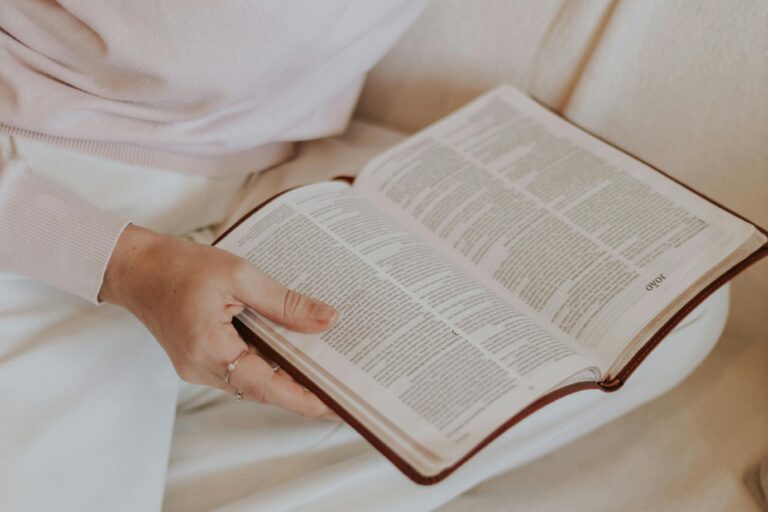
Reading the Bible is one of the most important spiritual disciplines. Yet many Christians struggle to make it a consistent habit.
In fact, research shows that only 32% of Christians read the Bible daily, 12% never read the Bible and only 18% have read the entire Bible.
If you’ve ever felt overwhelmed by where to start, how to stick with it, or what to do when the words feel confusing, this guide is for you.
But first…
This article contains affiliate links. This means if you click on a link and make a purchase, I may get a commission, but you will not be charged a penny more. Thanks for your support!
Why should we read the Bible?
There are so many good reasons to read the Bible!
- It helps us grow closer to God (James 4:8)
- It gives us wisdom and guidance (Psalm 119:105)
- It helps us avoid sin (Psalm 119:11)
- It helps us resist temptation (Matthew 4:1–11)
- It helps us become less worldly and more godly (Romans 12:2)
- It strengthens our faith (Romans 10:17)
- It changes our character (Hebrews 4:12)
- It helps is live a life that pleases God (2 Timothy 3:16-17)
- And the Bible tells us to! (Joshua 1:8)
For a deeper dive into why Bible reading matters, check out this guide >>> Why should Christians read the Bible?
But if you are like most Christians, you are thoroughly convinced you SHOULD be reading the Bible… it’s the actual DOING it that’s hard!
How to start reading the Bible: a step-by-step guide
If you are new to reading the bible, or if you have tried in the past but struggled with it or got stuck, here’s what I recommend…
Step 1: Pick a book or a bible reading plan
You can start by simply choosing one book of the Bible to read.
And it doesn’t have to be Genesis!
A good place to start is with one of the Gospels, like Matthew or Luke. Aim to read one chapter per day. If you find that is too much, aim to read one section per day.
Another good option is to follow a structured Bible reading plan.
Bible reading plans can help give you direction and balance. And they can really help with consistency. Best of all, they reduce decision fatigue – you don’t have to decide each day what to read, you just read whatever’s next on your plan.
Later in this guide, I’ll share some options for different types of plans depending on your goals.
Step 2: Pray first
Before you read, take a moment to ask God to help you understand what you are reading and speak to you through his Word.
For example: “Lord, please speak to me through your Word today – please help me understand what I am reading and how I should apply it to my life.”
Step 3: Use the S.O.A.P. method
Many Christians find the S.O.A.P. method helpful for structuring their Bible reading times:
- Scripture: Simply read today’s passage.
- Observation: Note what stands out – repeated words or phrases, key themes, what it tells you about God’s character, any questions you have, and anything else that stands out to you.
- Application: Ask yourself, “What should I do differently in light of this passage?” Jot down one or two actionable steps.
- Prayer: Respond to God through prayer. Praise Him for what the passage has shown you about his character, confess any sins the passage has highlighted, thank him for what the passage says he has done for you, and ask him for help to live out what you have learned in your daily life.
Step 4: Keep a journal
Keeping a journal helps you remember what you’ve read, process what God is teaching you and track your spiritual growth. It also keeps you accountable!
As you go through the S.O.A.P. method, jot down any verses that stand out, as well as your observations and applications. Some people also find it helpful to write down their prayers as well.
Periodically, go back through your journal to see what God has been teaching you over time and how much you have grown. This will also remind you of any applications you’ve forgotten about or stopped doing!
Step 5: Be a doer of the word, not just a hearer
Don’t just read God’s word – put it into practice!
In James 1:22, the Bible calls us to act on what we learn:
“Do not merely listen to the word, and so deceive yourselves. Do what it says.” (NIV)
Whenever you read the Bible, always ask yourself: “What is the application?” and then take steps to put it into practice!
Suggested Reading Plans
- Genesis to Revelation (Canonical) – Just read straight through the Bible from start to finish. A simple, DIY approach. Good if you want a straightforward plan, but the downside is you’ll hit some tricky books early on and you might get stuck!
- The MNM-GLEJ Method (Gospel First) Start with Matthew, then read the New Testament, followed by the Old Testament. Space the other Gospels out evenly. Read one chapter per day. Good if you want a simple, straightforward plan that doesn’t start with the Old Testament, plus it helps you read the Old Testament in the light of the New Testament. The downside is, it takes a little over 3 years to read the whole Bible!
- The Bible Recap (Chronological) Read the entire Bible in a year with daily summaries and engaging commentary. Great for those who want structure and context. But it’s a lot of reading (roughly 3 chapters per day) AND there are a lot of tricky books (like Job and Leviticus) very early on.
READ MORE >>> Which Is the best Bible reading plan?
When Should You Read the Bible?
The truth is, you can read the Bible any time you like. But I highly recommend reading first thing in the morning.
Why?
Well firstly, because it’s less likely to get skipped. The later in the day you put your Bible reading time, the greater the chance of something happening that means you decide to skip it or that you just forget to do it altogether.
And secondly, because it sets the tone for your whole day.
If you start your day with social media, TV, the news and/or notifications on your phone – THAT sets the tone for your whole day – you’re more likely to be anxious, stressed, fearful or annoyed and you are much more likely to spend the day conforming to “the pattern of this world” (Romans 12:2).
But if you start you day in God’s Word, THAT sets the tone for your whole day.
If you start with who God is, what he has done, how he sees you and his values, you’re more likely to be peaceful, joyful, kind, loving, patient, gentle and godly throughout the rest of the day.
And you are much more likely to be a positive influence on the world, rather than be negatively influenced by it.
But it doesn’t have to be the very first thing you do in the morning!
Personally, I like to have a shower and get dressed first, then read my Bible straight after that, but before eating breakfast with my family. That way, I am more awake and alert when I read my Bible, but everything else in my day happens after my Bible time.
Of course, if first thing in the morning is completely impossible for you then choose a different time in the day. Choosing a time you know you can stick to consistently matters more than the specific time.
How long should Bible reading take each day?
The length of time doesn’t matter as much as consistency.
If you are new (or new-ish) to reading the Bible, and you don’t yet have an established routine, I recommend starting with just 10 minutes a day.
What you’ll find is that, more often than not, you’ll end up reading for longer. But the real key to developing a Bible habit is to keep showing up every day, even if it’s only 10 minutes.
Once you have a steady habit, gradually increase your time: 15 minutes, then 20 and so on.
But remember: 10 minutes every day that you actually DO is far better than a PLAN to read the Bible for much longer that never actually happens!
How to stay consistent with Bible reading
Consistency is the secret to building a lifelong habit. Here are some practical tips:
- Do it in the morning – first thing if possible.
- Start small and build up – don’t overwhelm yourself when you’re just starting out.
- Prioritize consistency over “perfection” – some days will feel difficult. Just keep going.
- Accept that some days will feel dry – God still speaks even when it doesn’t feel exciting.
- Don’t stress about understanding everything – you won’t understand it all the first time through.
- Consider not starting with Genesis – for some, beginning with the Gospels or a plan like MNM-GLEJ is more engaging.
- Keep a journal – track observations, applications and prayers.
What to do when you don’t understand the Bible
It’s normal not to understand everything in the Bible.
If you are confused by a verse or passage, here are a few things you can try:
- Pray!
- Use a Bible that has study notes
- Use a Bible commentary
- Read the passage in a few different translations
- Try reading a modern paraphrase, like The Message
- Discuss your questions with your pastor, a mentor or a mature Christian friend
But it’s also important to remember that understanding grows over time. You won’t understand everything the first time through the Bible.
When you get to a tricky passage that you find very confusing, it’s totally OK to just accept you don’t understand that bit and move on. It’s far more important to keep going and stay consistent.
Some have likened understanding the Bible to peeling back layers of an onion. Every time you read the Bible you’re peeling off one layer to discover there’s another layer underneath… things you didn’t spot previous times, new insights, and a deeper understanding of God and his Word.
Truth be told, none of us will fully understand everything in the Bible this side of Heaven!
What to do when Bible reading feels dry
Even consistent Bible readers go through seasons of dryness, when it feels like God is distant or you’re not learning anything, or when you’re grappling with “boring” passages and tricky books.
Here’s what you can do when Bible reading feels dry:
- Pray! Ask God to help you enjoy reading his Word.
- Keep showing up – even when it’s hard. You’ll get through this!
- Try reading a different Bible translation for a while.
- If you’re really struggling with a particular book of the Bible, skip that book for now and come back to it later.
- If you are really struggling with your bible reading plan, try a different one.
Whatever you do, don’t give up! The more you persevere, the more you’ll grow in your understanding and the more joy you will have reading God’s word.
What to do if you miss a day… or a week… or a month…
It happens to the best of us.
Life gets busy. A major life event messes up your schedule. The snooze button gets the better of you. Or else those tempting notifications on your phone somehow steal your allotted Bible time each day.
And so you miss a day a day… or a week… or a month… or longer!
The important thing is not to beat yourself up about it.
Just figure out what you can do to carve out 10 minutes a day, as early as possible in your day, then start again.
If your old slot no longer works, pick a new one.
If that snooze button is proving too tempting, put your alarm on the other side of the room.
If those phone notifications are always your downfall, buy an actual alarm clock… and don’t check your phone until AFTER your Bible reading time.
If reading the Bible keeps dropping off the end of the to-do list, do it earlier in the day.
If necessary, get up 10 minutes earlier every day.
Just do your best and keep going. Aim for consistency and don’t set up unrealistic expectations for yourself!
Final Thoughts
Start small, keep it consistent and let God transform you one page at a time.
Every day you show up is a victory.
And remember, reading the Bible isn’t a race or a task to cross off the to-do list…
It’s a daily appointment with the Creator of the Universe!
What could be more exciting that that?
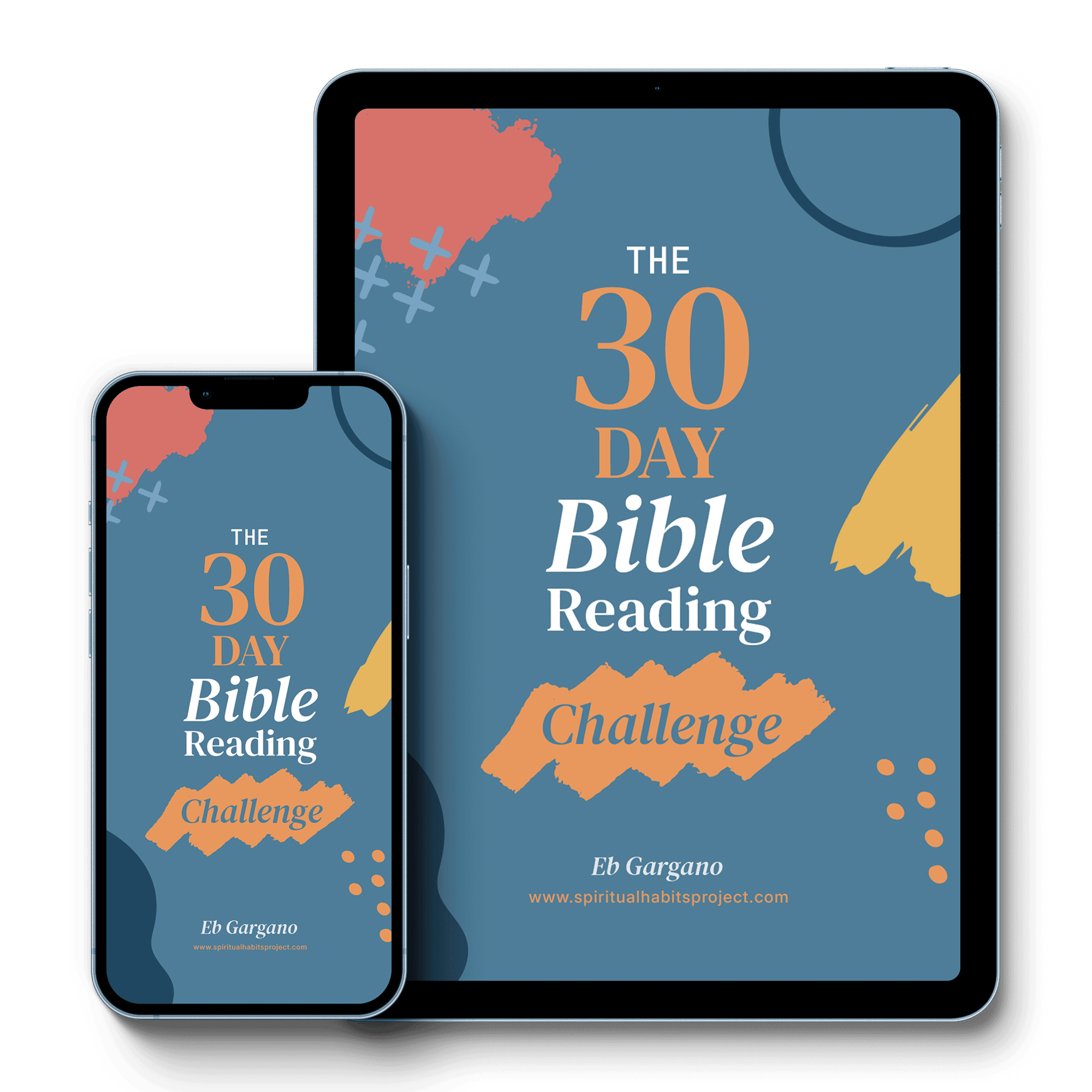
Your Next Step: The 30 Day Bible Reading Challenge
If you want help building a consistent Bible reading habit, then I invite you to join the 30 Day Bible Reading Challenge.
Each day includes:
- A short Scripture passage to read
- A brief teaching on the passage
- A guided prayer activity
- A short, related challenge to do at another point in the day
- Reflection questions to help you track your growth
In just 30 days, you’ll begin to build a foundation for a steady, sustainable Bible reading habit
Join the 30 Day Bible Reading Challenge!
Recommended resources for reading the Bible
- God’s Big Picture – Vaughan Roberts
- The Bible Course – The Bible Society
- The Bible Recap – Tara-Leigh Cobble
- The Bible Revealed – Philip Yancey & Brenda Quinn
- The NIV Life Application Study Bible – Tyndale House
READ MORE >>> Recommended resources for reading the Bible
Pin this article
Scripture copyright and permissions
For information about the Bible translations used on this website and their copyright notices, please see the Scripture copyright and permissions page.