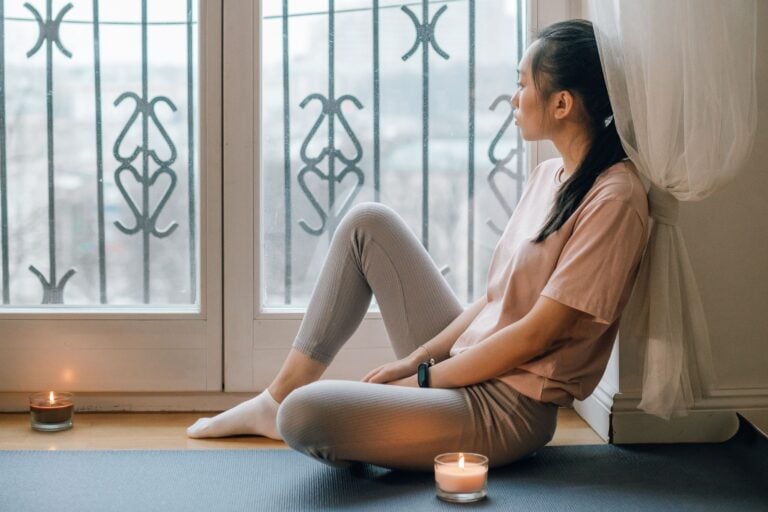
The twin disciplines ofsilence and solitude have somewhat fallen by the wayside in recent years, and yet they are needed more than ever as an antidote to the noise and distraction of the 21st century.
However, precisely because these two disciplines have fallen out of fashion, many people are now unsure how to even go about practising them.
Maybe that’s you?
Maybe you know that your body, mind and spirit desperately need to rediscover this ancient spiritual discipline but you are unsure where to start
In this article we will cover how to get started practising the spiritual discipline of silence and solitude, how to grow in this discipline and how to deal with some of the many pitfalls that threaten to derail this important discipline.

This article contains affiliate links. This means if you click on a link and make a purchase, I may get a commission, but you will not be charged a penny more. Thanks for your support!
1. Start small
If you are new to the spiritual discipline of silence and solitude, I strongly recommend that you DO NOT begin with a week-long silent retreat!
Start small.
I recommend you start with 10 minutes.
For some 10 minutes may even be too hard.
If that’s you, start with 1 minute.
The discipline of silence and solitude, like all the other spiritual disciplines, is like a muscle, it takes time to build your “strength”, but the more you do it the “stronger” you’ll get.
In the case of silence and solitude, the more you do it, the easier it will get, the longer you’ll be able to practise it for and the more joy and peace it will bring you.
2. Find a place where you can be alone
Obviously, in order to practise the discipline of solitude, you need to find a place where you can be completely alone.
For most people, this will be a room in their house where they can shut the door and be completely alone – perhaps a study, a living room, a bedroom or a dining room.
Ideally this will also be a room in the house without screens.
(For this precise reason, my favourite place to practise silence and solitude is in my bedroom, where there are no screens or devices.)
If the best room in the house for you has screens / devices that can’t be removed easily from the room (e.g. a TV or a games console), at least ensure they are completely turned off.
Alternatively, if there isn’t a suitable room in the house OR you are an outdoorsy sort of person, you may find a quiet place outside in nature is a better option for you.
Wherever you choose, try to make this your regular “place” – the place where you come whenever you want to spend quality time with God.
Over time, your mind and soul will begin to associate that place with spending time alone with God, and you will find it easier and easier enter into silence and solitude.
It may be that you will need to experiment with several different places – both inside and outside – in order to find your “place”. That’s totally fine – take time to try out different locations and see what works best for you!
3. Remove all distractions
One of the biggest threats to our ability to practise silence and solitude is distraction – especially digital ones.
If we are not careful, our digital devices can completely sabotage our ability to practise the spiritual disciplines of silence and solitude.
It is impossible to practise silence and solitude if we are being constantly interrupted by beeps, pings and buzzes!
So then, as far as is possible, try to completely remove all digital devices, screens and any other distractions from your “place”.
Leave portable devices, such as your phone and tablet in another room altogether.
(Evidence shows that even if your phone is on silent, if it’s in the same room as you, it is still a distraction.)
And if there are any devices that can’t be physically removed from the room, ensure they are completely turned off so they can’t distract you.
4. Tell people what you are up to
Of course digital devices are not the only possible distractions.
The humans in our life also have the potential to distract us too!
You definitely do not want your family / housemates to be constantly wandering in and out of your “place” while you are trying to spend time alone with God in silence and solitude!
Therefore you should also seek to eliminate human distractions as much as possible.
A practical way to deal with this is simply to have a chat with the other people who live in your house.
Tell them that you want to practise the spiritual disciplines of silence and solitude and ask them not to disturb you for the next 10 minutes or so.
5. Create total silence
It might sound obvious, but to practice the spiritual discipline of silence, you need complete silence.
That obviously means no TV/radio/Netflix/podcasts on in the background.
But is also means NO MUSIC!
This is deeply countercultural.
We as humans have grown so accustomed to constant noise that many of us find total silence really hard.
If that’s you, do not write this discipline off as something that’s not for you. There are huge spiritual and medical benefits to silence.
Instead, take it as a sign that you really need to practise this discipline!
And be encouraged that, by regularly practising the twin disciplines of silence and solitude you will, over time, grow to find great joy and peace in silence.
(And if necessary, start even smaller than 10 minutes. Start with 1 minute and gradually build up.)
6. Set a timer
This is optional, but recommended.
I recommend you set a timer for 10 minutes – or however long you have chosen to spend in silence and solitude.
This means you can stay completely focused on being in God’s presence for those 10 minutes.
If you don’t set a timer, there’s a good chance you’ll keep distracting yourself by constantly checking your watch to see if time is up…
But of course, don’t use the timer on your phone!
Instead, invest in a cheap digital timer. (A quiet one, obviously, not one that ticks constantly!)
By doing this, you’ll be able to stay completely focused on God the whole time.
7. Start with a brief prayer
Pray a brief prayer to begin your time of silence and solitude.
It doesn’t need to be long or complicated – in fact it shouldn’t be long or complicated.
Simply tell God that you are setting aside this time to spend alone with him in silence and solitude and ask him to help you do that, and to meet with you in the silence.
8. Be still
Then, simply be still and wait.
Most people find it helpful to keep their eyes shut, as this further removes distraction.
Then just sit in the silence and the solitude and simply “be” with God.
This will almost certainly feel strange and awkward at first, but with practice this will become much easier and bring great joy and peace.
You will also, most likely, find that your own thoughts start to intrude and distract you. Don’t worry if that happens. Don’t judge yourself, beat yourself up or give up altogether if that happens. Just bring your focus back to sitting in God’s presence.
Some people find it helpful to pray a simple word or sentence every time they find themselves getting distracted, such as “Come Holy Spirit”, “Come Lord Jesus” or simply just “Jesus”.
9. Pay attention to what God might be saying to you
When we give God space and time, he often speaks to us.
(Or maybe it’s that he was speaking all along, but when we turn down the noise of our lives we can finally hear him!)
However, it’s important not to try and force this, or come to our times of silence and solitude with any expectations or pressure.
The point of silence and solitude is not to force God to speak to you!
The point is to simply “be” in God’s presence.
If you don’t hear anything, that’s totally fine.
In fact, that will often happen.
Often you will sit in silence and solitude and just enjoy being in God’s presence.
And that’s a good thing!
Don’t feel like you’ve failed if you don’t hear anything.
But the truth is you will often hear God’s still, small voice in those times.
So, as you enter into a time of silence and solitude, be ready, willing and open to him speaking to you.
And if he does, resist the urge to open your eyes and immediately write it all down! (You can write it all down at the end.)
Instead just be attentive to what he is saying.
Sit with it, and see if he has anything more to say.
And just continue to rest in his presence.
10. Choose your own adventure!
When your timer goes off, you get to choose what happens next.
You may have heard something from God during your time of silence and solitude. In which case, I recommend you write down what you feel he has said to you and pray over it, asking God for confirmation, clarity and discernment.
Otherwise, you may feel prompted to stay in the quiet and:
- Read the Bible
- Pray
- Journal
- Worship
- Read a Christian book
Or you may decide you want to stay alone with God, but put on some worship music.
Or you may decide that you enjoyed your time in silence and solitude so much that you want to continue and go for longer.
Or you may decide that 10 minutes was enough for you and you are done – that’s OK too!
Silence and solitude is also a really good prelude to a daily quiet time.
Try starting your quiet time with a few minutes of silence: sit in God’s presence and simply “ be” with God, before you begin reading Scripture, praying and journaling.
Alternatively (or as well) it can be a really good way to close out a quiet time – simply sitting in the quiet and allowing God to minister to your soul, before you get started on the rest of your day.
11. Gradually extend your silence and solitude time
In our noisy, frenetic, distraction-filled 21st century lives, silence and solitude is deeply countercultural.
Because of this, your first experiences of practising this discipline are likely to feel odd and uncomfortable.
Our information-overloaded, dopamine-addled brains are likely to protest!
You may feel practising this discipline is “boring”, “awkward” or “a waste of time”.
You may experience a constant battle with racing thoughts and the most random of ideas popping into your brain.
All of this is totally normal!
Don’t give this up as a bad idea – the very fact you are struggling with this is a sign that you really need to practise this discipline.
But equally so, don’t force yourself to go longer until you are comfortable with 10 minutes. (Or 1 minute, if you started with 1 minute!)
But once you are comfortable with 10 minutes, I recommend you gradually extend your silence and solitude time.
Truth be told, once this becomes a regular part of your walk with God, you will likely begin to really want to spend longer in silence and solitude! And that “alone time with God” will begin to be something you look forward to and actively want to extend.
12. Rinse and repeat
Silence and solitude is not meant to be a “one time” thing.
We see from Jesus’ example that it is supposed to be a regular habit – a discipline!
Try to make spending time alone with God in silence and solitude at least a weekly habit (the Sabbath is ideal for this).
And ideally a daily habit.
Even better, combine the two.
Make it a daily habit to spend 5-10 minutes in silence and solitude – perhaps at the start or end of your quiet time each morning.
Then spend a longer period of time in silence and solitude as part of your weekly Sabbath practice.
Final thoughts
The twin disciplines of silence and solitude have fallen by the wayside in the 21st century – at just a time when we need them most!
As a result many Christians are not sure how to even begin practising this discipline!
I recommend you start small with 10 minutes, find a place when you can be alone, remove all distractions and simply “be” in God’s presence and allow him to minister to your soul.
Sometimes when we give God this kind of time and space, he speaks, so be attentive to that. But don’t try and force it. Sometimes he’ll speak, sometimes he won’t. Don’t feel like you’ve failed if you don’t hear anything.
Once you’re comfortable with 10 minutes, you can gradually extend the time you spend in silence and solitude.
The more you practise this discipline, the easier and more joyful you will find it.
Ideally this discipline will become a regular part of your daily and weekly routines.
Recommended books on silence & solitude
- The Ruthless Elimination Of Hurry – John Mark Comer
- The Solitude Practice – John Mark Comer
- Invitation to Solitude and Silence – Ruth Hayley Barton
- The Way Of The Heart – Henri Nouwen
- 12 Ways Your Phone Is Changing You – Tony Reinke
READ MORE >>> Recommended books on silence & solitude
Pin this article
Scripture copyright and permissions
For information about the Bible translations used on this website and their copyright notices, please see the Scripture copyright and permissions page.