
Silence and solitude are spiritual disciplines that seem to have almost completely fallen by the wayside in our 21st century world of constant busyness, distraction and noise.
But what if, far from being out of date and irrelevant to our busy, modern lives, they actually hold the key to many of the things we deeply long for: the ability to hear God more clearly, a closer relationship with God, a stronger faith and true rest for our souls.
(SPOILERT ALERT: the practice of silence and solitude offers all of those things and more!)
In this guide we’ll explore what the twin disciplines of silence and solitude are, why they matter so much and how you can take steps to prioritise silence and solitude in your everyday life.

This article contains affiliate links. This means if you click on a link and make a purchase, I may get a commission, but you will not be charged a penny more. Thanks for your support!
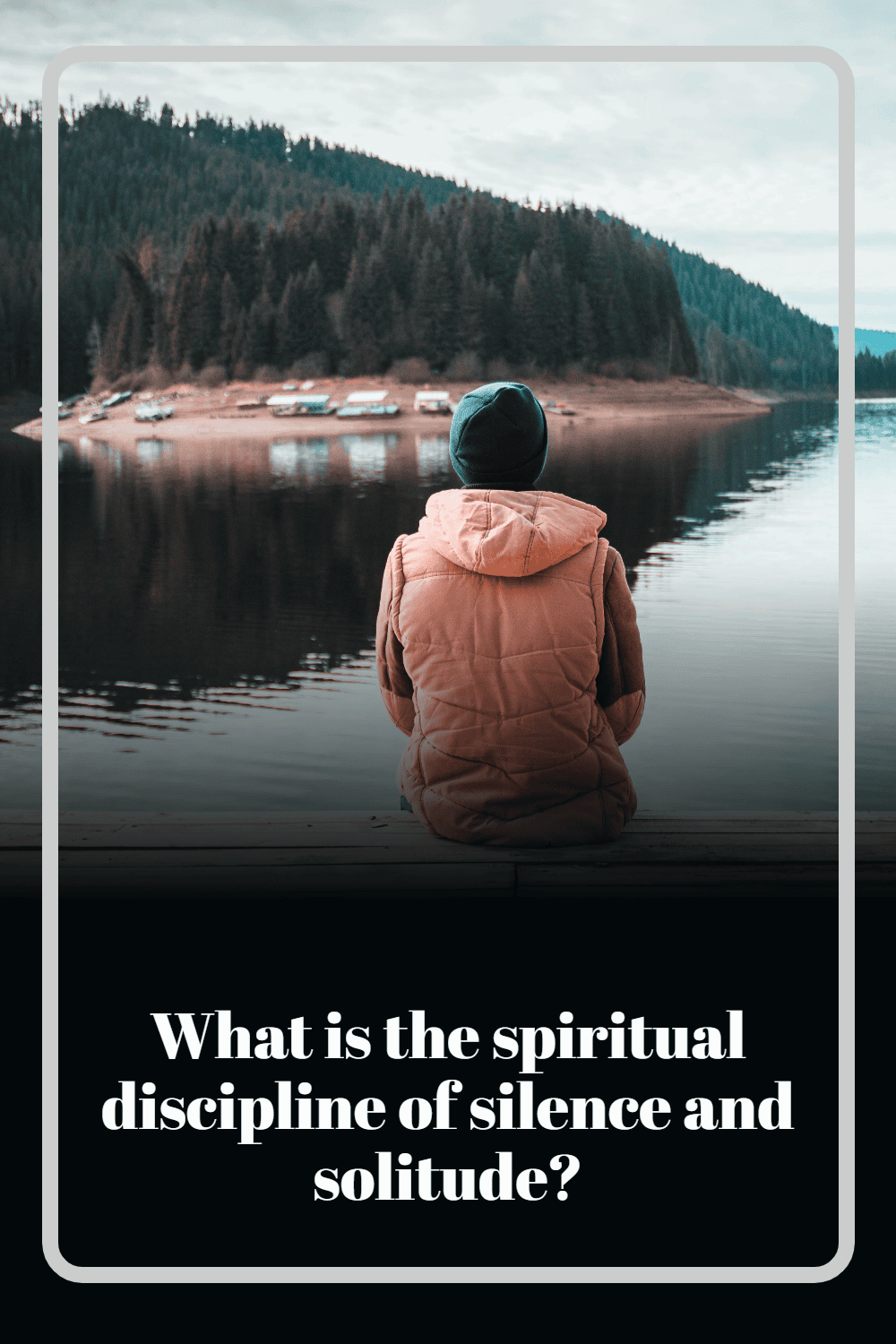
What is the spiritual discipline of silence and solitude?
But first things first…
What exactly is the spiritual discipline of silence and solitude?
In truth, silence and solitude are two separate disciplines:
- Silence is the intentional withdrawal from noise
- Solitude is the intentional withdrawal from people
In practice, they are deeply entwined and they both have the same aim: spending time alone in silence with God.
At its most basic, the practice of silence and solitude is simply sitting quietly in the presence of God. To do, what God calls us to do the Psalms and:
“Be still, and know that I am God” – Psalm 46:10a (NIV)
But the practice of silence and solitude can also mean spending time alone with God to read the Bible, pray, listen to God, worship and practise other spiritual disciplines.
This can be for a short time, for example a regular morning quiet time. Or it can be for a much longer time, for example a silent retreat.
READ MORE >>> What is the spiritual discipline of silence and solitude?
Why should Christians practise the spiritual discipline of silence and solitude?
As our world has become increasingly noisy and frenetic, the spiritual discipline of silence and solitude has fallen out of fashion.
And yet, it is precisely because our modern world is so noisy and frenetic, that we so desperately need to rediscover this ancient discipline of silence and solitude as a counterbalance to the constant barrage of distractions, noise, pings and notifications we all face on a daily basis.
Here are 4 reasons why Christians today in the 21st century should practice the ancient spiritual discipline of silence and solitude.
1. Jesus practised silence and solitude
If we want to be more like Jesus, we need to live like Jesus lived. And one of the hallmarks of Jesus’ life on earth was his regular practice of silence and solitude.
There are many examples in the Gospels of Jesus practising this discipline. In fact, it states clearly in the Scriptures that this was a consistent habit.
For example:
“Jesus often withdrew to lonely places and prayed.” – Luke 5:16 (NIV)
In fact, Jesus considered this discipline so important that it was the very first thing he did at the start of his public ministry:
“Jesus, full of the Holy Spirit, left the Jordan and was led by the Spirit into the wilderness, where for forty days he was tempted by the devil. He ate nothing during those days, and at the end of them he was hungry.” – Luke 4:1-2 (NIV)
2. It allows us to hear God more clearly
One of the problems with the barrage of noise and constant distraction that we are constantly exposed to in our frenetic 21st century lives is that it’s very hard to hear God over the noise.
If we never spend time alone with God in silence, how can we expect to hear from him clearly?
God often speaks in the same gentle whisper as he used when he spoke to Elijah on Mount Horeb:
“The Lord said, ‘Go out and stand on the mountain in the presence of the Lord, for the Lord is about to pass by.’ Then a great and powerful wind tore the mountains apart and shattered the rocks before the Lord, but the Lord was not in the wind. After the wind there was an earthquake, but the Lord was not in the earthquake. After the earthquake came a fire, but the Lord was not in the fire. And after the fire came a gentle whisper. When Elijah heard it, he pulled his cloak over his face and went out and stood at the mouth of the cave. Then a voice said to him, ‘What are you doing here, Elijah?’” – 1 Kings 19:11-13 (NIV)
The problem is, if we don’t choose to actively spend time in silence and solitude, we may never hear that gentle whisper over the constant hubbub of modern life.
3. It allows us to go deeper in our relationship with God
In the Psalms, God calls us to:
“Be still, and know that I am God” – Psalm 46:10a (NIV)
The word “know” here is the word yada in Hebrew and means so much more than mental awareness or head knowledge.
Yada implies having a deep understanding of who God is, based on an intimate relationship with him and personal experience of his character and actions.
When we spend time alone with God in silence and solitude, we go deep. We hear God better, but we also get to know God better. Our relationship with God grows deeper and stronger.
It’s the same with any relationship.
Imagine a married couple who never spent any time alone together, just talking and listening to each other. That marriage would definitely not grow deeper and stronger. At best, the marriage will be weak and shallow. At worst, the marriage will end in divorce.
In the same way, if we don’t spend time alone with God, just talking to him and listening to him, our relationship will not grow deep and strong. At best, our relationship with God will be weak and shallow. At worst, we will walk away from the relationship altogether.
4. It gives rest to our souls
Our souls desperately need rest.
It’s interesting that even secular scientists and health professionals are highlighting that our bodies and nervous systems are not built to handle the constant flood of digital information that we are exposed to in the 21st century.
As one study puts it:
“Chronic low-level stress from constant media exposure can keep your nervous system in a heightened state for hours, disrupting sleep, impairing concentration, and contributing to feelings of hopelessness or persistent worry.”
Ironically, many of the ways people try to deal with these symptoms actually exacerbate the problem. For example, doomscrolling, compulsive checking of notifications, gaming for hours on end and binge watching Netflix.
The real antidote to these symptoms is given to us in the Bible:
“Come to me, all you who are weary and burdened, and I will give you rest.” – Matthew 11:28 (NIV)
“The Lord is my shepherd, I lack nothing. He makes me lie down in green pastures,
he leads me beside quiet waters, he refreshes my soul.” – Psalm 23:1-3 (NIV)
True rest for our souls is found when we spend quality time with God, when we spend time alone with God in silence and solitude.
When we turn off the noise of our phones, TVs, radios, YouTube channels, podcasts, streaming platforms and games consoles, and come into the presence of God, God ministers to our souls, he restores our souls, he refreshes our souls and he gives our souls the rest they so desperately crave.
Spending time in silence and solitude brings peace, clarity and a renewed focus on what truly matters.
READ MORE >>> Why should Christians practise the spiritual discipline of silence and solitude?
Silence and solitude as a spiritual discipline
The twin disciplines of silence and solitude are considered spiritual disciplines because they require intention and consistency.
Spiritual growth isn’t about random bursts of devotion or occasional spiritual highs. It’s about building consistent rhythms that shape your heart over time.
Just as exercise strengthens the body, spiritual disciplines strengthen our relationship with God.
Silence and solitudesit alongside the other spiritual disciplines – like reading the Bible, prayer, fasting, worship and fellowship – each one helping us remain rooted in God and formed into the likeness of Christ.
READ MORE >>> What are the spiritual disciplines?
Why “unplugging” is a necessary part of silence and solitude in the 21st century
Unplugging as a spiritual discipline is not mentioned in the Bible, for obvious reasons!
But it is most certainly a modern spiritual discipline that desperately needs to be practised as part of the ancient discipline of silence and solitude.
Imagine for a moment that the Bible was set in the 21st century…
Can you honestly imagine that, when Jesus “withdrew to lonely places and prayed”, he would take his iPhone with him and doomscroll at the same time? Or that he’d read the Scriptures with Netflix on in the background? Or that he’d allow his precious alone time with the Father to be constantly interrupted by the buzzes and pings of his digital devices?
Of course he wouldn’t… That sounds quite ridiculous!
And yet, how many of us allow ourselves to be interrupted and distracted by our phones while in the middle of praying, reading the Bible, worshipping and during our quiet times?
How many of us spend more time on our screens than we do alone with God in silence and solitude?
In fact, how many of us spend close to ZERO time alone with God each day and nearly all of the rest of the time on our iPhones, in front of our TVs, tablets and computers, or on some other digital device?
Of course, modern life is such that it has become almost impossible to spend ZERO time in front of a screen each day, but that doesn’t mean we should just shrug our shoulders and write it off as a lost cause!
That’s where the modern spiritual discipline of “unplugging” fits in.
Unplugging is deliberately going without our digital devices for a period of time, so we can spend uninterrupted, quality time focused 100% on God.
In its most basic form, this discipline can be as simple as switching off your phone or putting it in another room while you spend time in silence and solitude with God.
On the other hand, some people take this discipline of “unplugging” one step further and practise a “digital Sabbath” – one day a week when your phone and other digital devices are either turned off completely or drastically limited.
The crazy thing is, even secular health experts are now recommending a “digital detox” as a way to restore mental clarity, increase productivity, improve sleep and mental health, improve relationships with family and friends, and feel more “present” in the moment.
If this is being recommended by secular health professionals, how much more do we as Christians need to adopt this practice of regularly “unplugging” in order to increase our spiritual clarity, go deeper in our relationship with God, hear God more clearly and grow spiritually?
READ MORE >>> Unplugging as a spiritual discipline
How to practise the spiritual discipline of silence and solitude
Hopefully you are by now fully convinced that silence and solitude is an essential spiritual discipline, that it is ever more important as an antidote to the noise and distraction of the 21st century and that it is hugely beneficial – to our physical heath, our mental and our spiritual health.
But maybe you are wondering how to go about it, how exactly to practise the spiritual discipline of silence and solitude.
Building a silence and solitude habit doesn’t have to be complicated or overwhelming. Here are some practical steps to get started:
1. Start small
If you are new to the spiritual discipline of silence and solitude, I strongly recommend that you DO NOT begin with a week-long silent retreat!
Start small.
I recommend you start with 10 minutes.
2. Find a place where you can be alone
To practise the discipline of solitude, you need to find a place that you can be alone.
Ideally this will also be a room in the house without screens.
If the best room in the house for you has screens / devices that can’t be removed easily from the room, at least ensure they are completely turned off.
Alternatively, you may find a quiet place outside in nature is a better option for you.
Wherever you choose, try to make this your regular “place” – the place where you come each time you want to spend quality time with God.
Over time your mind and soul will begin to associate that place with spending time alone with God.
3. Remove digital distractions
As we’ve looked at above, one of the biggest threats to our ability to practise silence and solitude is digital distractions.
As far as is possible, try to completely remove all digital devices from your “place”.
For example, leave your phone and tablet in another room and completely turn off any devices that can’t be physically removed from the room.
4. Tell people what you are up to
You do not want your family to constantly be walking in and out of your “place” while you are trying to spend time alone with God in silence and solitude!
So tell the people in your house what you are up to and ask them not to disturb you for the next 10 minutes or so.
5. Create total silence
It might sound obvious, but to practice the spiritual discipline of silence, you need total silence.
That obviously means no TV/radio/Netflix/podcasts on in the background.
But is also means no music.
You may find this hard to begin with, but as you practice, you will gradually grow to be accustomed to it – and you will eventually come to enjoy it.
6. Set a timer
Set a timer for 10 minutes – or however long you have chosen to spend in silence and solitude.
This means you can stay completely focused on being in God’s presence, rather than constantly being distracted by checking your watch.
(Not the timer on your phone, obviously! Buy a cheap digital timer.)
7. Start with a brief prayer
Close your eyes and pray a brief prayer to begin your time with God.
Offer up this time to him and ask him to meet with you in the silence.
8. Be still
Then just sit in the silence and the solitude and simply “be” with God.
No expectations, no agenda. Just sit in his presence.
9. Pay attention to what God might be saying to you
As we have covered earlier, when you give God space and time, he often speaks. (And/or we are finally able to hear him!)
That being said, don’t force it.
The point of silence and solitude is not to force God to speak to you!
The point is to simply “be” in God’s presence.
If you don’t hear anything, that’s totally fine.
But be ready, willing and open to him speaking to you.
If he does, resist the urge to open your eyes and immediately write it all down.
Instead just be attentive to what he is saying. (You can write it all down at the end!)
10. Choose your own adventure!
When your timer goes off, you get to choose what to do next.
If you have heard from God, I recommend you write down what you feel he has said to you.
Otherwise, you may feel prompted to stay in the quiet and practise other spiritual disciplines, such as reading your Bible, praying or journalling.
Or you may decide that 10 minutes was enough for today. That’s OK too!
11. Gradually extend your silence and solitude time
At first, 10 (or even 1) minute in silence and solitude is likely to feel strange and awkward. Don’t force yourself to go longer until you are comfortable with 10 minutes.
But once you are comfortable with 10 minutes, I recommend you gradually extend your silence and solitude time.
(Truth be told, once this becomes a regular part of your walk with God, you will likely begin to really want to spend longer in silence and solitude! And that “alone time with God” will begin to be something you look forward to and actively want to extend.)
12. Rinse and repeat
Silence and solitude is not meant to be a “one time” thing.
We see from Jesus’ example that it is supposed to be a regular habit – a discipline!
Try to make it at least a weekly habit (the Sabbath is ideal for this).
And ideally a daily habit.
Even better, combine the two.
Make it a daily habit to spend 5-10 minutes in silence and solitude – perhaps at the start of your quiet time each morning.
Then spend a longer period of time in silence and solitude as part of your weekly Sabbath practice.
READ MORE >>> How to practise the spiritual discipline of silence and solitude
Final Thoughts
Silence and solitude as a spiritual discipline has fallen out of fashion in the 21st century – at just the point when we need it most!
The spiritual discipline of silence and solitude is the deliberate practice of spending time alone with God, away from noise and people.
Silence and solitude was a discipline that Jesus practised regularly. Today, it helps hear God more clearly, it helps us grow deeper in our relationship with God and it gives rest to our souls – something we all desperately need in our noisy, frenetic, distraction-filled, modern lives.
As you begin to practise this discipline, start small – spend 10 minutes alone in the silence with God, don’t come with any expectations other than to simply “be” with God and allow God to minister to your soul.
At first, spending time in silence and solitude may feel strange and awkward, but over time, you will grow to love it and genuinely look forward to it.
Recommended books on silence & solitude
- The Ruthless Elimination Of Hurry – John Mark Comer
- The Solitude Practice – John Mark Comer
- Invitation to Solitude and Silence – Ruth Hayley Barton
- The Way Of The Heart – Henri Nouwen
- 12 Ways Your Phone Is Changing You – Tony Reinke
READ MORE >>> Recommended books on silence & solitude
Pin this article
Scripture copyright and permissions
For information about the Bible translations used on this website and their copyright notices, please see the Scripture copyright and permissions page.