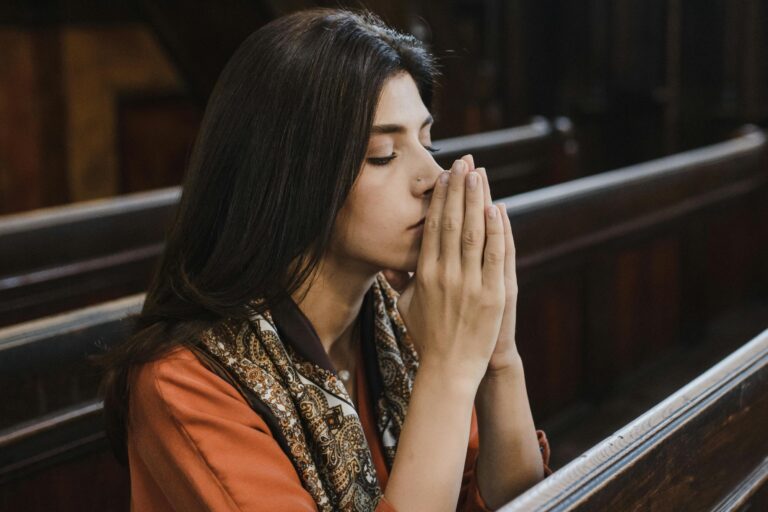
Prayer is one of the most well-known spiritual disciplines – and yet it’s often seen as difficult, confusing… or even boring!
At its core, prayer is simply a conversation with God. It’s how we speak to him, listen to him and gradually align our hearts to his will.
But prayer is so much more than a routine or a set of words.
Prayer is a relationship.

This article contains affiliate links. This means if you click on a link and make a purchase, I may get a commission, but you will not be charged a penny more. Thanks for your support!
If you’re new to the topic of prayer, you may want to begin with my complete overview of the spiritual discipline of prayer. But here, we’re going to go deeper into why we should pray…
Prayer is a conversation with our Heavenly Father
Throughout Scripture, prayer is presented not as a ritual to perform or a task to cross off the to-do list, but as a conversation with a personal, loving God.
When Jesus teaches his disciples to pray, he begins with these words:
“This, then, is how you should pray: ‘Our Father in heaven, hallowed be your name.’” – Matthew 6:9 (NIV)
That opening phrase tells us something profound.
Prayer is rooted in relationship.
The apostle Paul echoes this relational language:
“Because you are his sons, God sent the Spirit of his Son into our hearts, the Spirit who calls out, ‘Abba Father.’” – Galatians 4:6 (NIV)
“Abba” is an intimate term – similar to “Dad” or “Daddy”.
When we pray, we are not trying to appease a distant deity or manipulate a cosmic force. We are having a chat with our Heavenly Father – who knows us, loves us and delights in having a relationship with us.
Prayer is both speaking and listening
We often think of prayer as talking TO God – and it certainly includes that.
We praise him for who he is and thank him for what he has done. We confess our sins and ask for his forgiveness. And we bring our requests to him – for ourselves and others.
But prayer is not only about speaking. It is also about listening.
Throughout the Bible we see that God is not silent. He speaks to his people in many different ways, and those who walk closely with him learn to recognise his voice.
In the Old Testament, God frequently spoke to his people in an audible voice. For example, when the young boy Samuel first heard God calling his name, he responded with the famous words:
“Speak, for your servant is listening.” – 1 Samuel 3:10 (NIV)
Samuel’s posture is a beautiful picture of listening prayer – a heart that is ready and willing to hear from God.
We see something similar with Moses. Moses regularly spoke with God while leading the Israelites. Exodus tells us:
“The Lord would speak to Moses face to face, as one speaks to a friend.” – Exodus 33:11 (NIV)
God not only listened to Moses’ prayers – he responded, guiding him and revealing his will.
The same pattern continues in the New Testament. In John’s Gospel, Jesus teaches that his followers will recognise and respond to his voice. He says:
“My sheep listen to my voice; I know them, and they follow me.” – John 10:27 (NIV)
This is a powerful picture of prayer as a relationship. Just as sheep learn to recognise the voice of their shepherd, so we can learn to recognise the voice of Jesus. As we spend time with him in prayer and in his Word, we become more familiar with his voice and more sensitive to his guidance.
Later, the early Church also experienced God speaking as they prayed together. In Acts 13, while the believers were worshipping and seeking God’s direction, the Holy Spirit gave clear guidance:
“Set apart for me Barnabas and Saul for the work to which I have called them.” – Acts 13:2 (NIV)
These examples remind us that prayer is not meant to be a one-sided conversation. God invites us not only to speak to him, but also to listen for his guidance, wisdom and encouragement.
Of course, God most often speaks through his Word, the Bible. As we read Scripture, the Holy Spirit often brings particular verses to our attention, convicting us, encouraging us, or guiding our next steps.
But God can also speak to us in other ways. Sometimes he speaks in an audible voice, but more often he speaks through a sudden thought, word, verse or picture that pops into our minds. Or sometimes he speaks through dreams, visions, worship songs, circumstances or even other people.
Learning to listen to God in prayer takes practice. It may not happen instantly or dramatically. But over time, as we regularly spend time with God, we begin to recognise his voice more clearly.
One simple way to practise listening prayer is to pause after you have spoken to God and ask something like:
“Lord, is there anything you want to show me or teach me today?”
Then sit in silence for a couple of minutes and pay attention to what comes to mind – perhaps a Bible verse, a conviction, a reminder, or a sense of direction.
You may find it helpful to write these thoughts down in a journal so you can reflect on them later.
If you don’t hear anything – that’s OK. The important thing is that you give God space to speak.
Prayer is participation in God’s work
One of the great mysteries of prayer is that God chooses to involve us.
Scripture shows again and again that prayer makes a difference:
“The prayer of a righteous person is powerful and effective.” – James 5:16 (NIV)
God is sovereign. He is fully capable of acting without us. And yet, in his wisdom, he invites us to pray – and works through those prayers.
READ MORE >>> Why should I pray?
Prayer is alignment
Prayer is more than just a conversation… it’s also a transformation.
The more we pray, the more our hearts become aligned to God’s will.
The more we pray, the less we want God to carry out OUR agenda and the more we want to carry out HIS agenda.
Jesus models this beautifully in the Garden of Gethsemane:
“Father, if you are willing, take this cup from me; yet not my will, but yours be done.” – Luke 22:42 (NIV)
Even in anguish, Jesus submits his desires to the Father’s will.
In the Lord’s Prayer, He teaches us to pray:
“Your kingdom come, your will be done, on earth as it is in heaven.” – Matthew 6:10 (NIV)
Prayer shapes us. It makes us humble. And it gradually tunes our hearts to desire what God desires.
That doesn’t mean we shouldn’t ask God for anything. Scripture encourages us to ask for things:
“In every situation, by prayer and petition, with thanksgiving, present your requests to God.” – Philippians 4:6 (NIV)
“Give us today our daily bread.” – Matthew 6:11 (NIV)
But we should bring our requests with humility, recognising that ultimately God knows better than we do what’s best for us.
Prayer is ongoing, not occasional
Prayer is not supposed to be a “break the glass in case of emergency” thing.
Nor is it supposed to be something we only do at church or at formal prayer meetings.
Prayer should be something we do every day.
After all, prayer is a relationship and, as any good relationship counsellor will tell you, frequent, honest communication is key to a good relationship.
If prayer is not currently something you are doing every day, I encourage you to start a daily prayer habit – start with just 5 minutes per day, and grow from there.
But if you’re already doing that… don’t rest on your laurels!
Prayer is not meant to be confined to a few minutes in the morning.
Paul writes:
“Pray continually.” – 1 Thessalonians 5:17 (NIV)
This doesn’t mean speaking nonstop words all day. It means living with an open line of communication – turning to God throughout the ordinary moments of life.
Short prayers. Silent gratitude. Quick cries for help. Pauses of praise.
As your prayer life grows, prayer will become less of an event and more a way of life.
What prayer is not
It can also be helpful to clarify what prayer is not.
Prayer is not:
- A performance to impress God or other humans (Matthew 6:5–6)
- A way to earn God’s favour
- A magic formula that guarantees a specific outcome
- A last resort when everything else fails
Why understanding prayer matters
If we think prayer is about saying the right words, we’ll feel inadequate.
If we think it’s about earning God’s favour, we’ll treat it as a task.
If we think it’s about instant results, we’ll feel disappointed.
If we treat prayer as a last resort, we’ll miss out on the joy of prayer.
But when we understand prayer as relationship – a conversation with our loving Heavenly Father – everything changes.
Prayer becomes a joy and a delight rather than obligation.
Your next step: The 30 Day Prayer Challenge
If you want help building a consistent prayer habit, I invite you to join the 30 Day Prayer Challenge.
Each day includes:
- A short Scripture passage to read
- A brief teaching on the passage
- A guided prayer activity
- A short prayer-related challenge to do at another point in the day
- Reflection questions to help you track your growth
In just 30 days, you’ll begin to build a foundation for a steady, sustainable prayer life.
Join the 30 Day Prayer Challenge

Final Thoughts
If you’ve ever felt unsure about prayer, you’re not alone.
The good news is that you don’t need the perfect words. You don’t need to be a super-Christian… and you certainly don’t need a degree in theology.
You simply begin.
Speak honestly to God. Give him space to speak to you. And keep coming back each day to continue the conversation and grow in your relationship with God.
Prayer is kind of like a muscle – the more you do it, the better you get at it.
And the good news?
“Come near to God and he will come near to you.” – James 4:8 (NIV)
That invitation stands today.
You just need to start.
And keep showing up each day.
Recommended books on prayer
- How to Pray: A Simple Guide for Normal People – Pete Greig
- Praying Like Monks, Living Like Fools – Tyler Staton
- Prayer: Experiencing Awe and Intimacy with God – Timothy Keller
READ MORE >>> Recommended books on prayer
Pin this article

Scripture copyright and permissions
For information about the Bible translations used on this website and their copyright notices, please see the Scripture copyright and permissions page.